

Hypochlorous Acid vs. Apple Cider Vinegar for Dog Ears: What Vets Actually Recommend

Updated September 1, 2026 · 8 min read
Listen to this article
Read aloud in your browser. Product blocks and navigation are skipped.
In This Article
- Loading contents…
If your dog is constantly scratching their ears, shaking their head, or giving you that unmistakable “please do something about this” look, it’s tempting to reach for a home remedy.
Apple cider vinegar is one of the most common suggestions you'll find online. Meanwhile, hypochlorous acid has become increasingly popular in pet-care products designed to clean and soothe irritated skin and ears.
So which one should you actually use?
So which one should you actually use? Trusting veterinary advice is key, as vets discourage DIY vinegar for inflamed ears to protect your dog and your peace of mind.
But there's an important catch: neither should be viewed as a substitute for diagnosing an actual ear infection.
Here's what dog owners should know.
Why Are Dog Ears So Prone to Problems?
A dog's ear canal isn't simply a short tube that you can wipe clean.
The canine ear canal has a vertical portion followed by a horizontal portion. That shape makes it easier for moisture, wax, debris, and microorganisms to become trapped.
This is one reason some dogs—particularly those with allergies, floppy ears, narrow canals, or frequent water exposure—can develop recurring ear problems.
Common signs include:
-
Head shaking
-
Scratching at the ears
-
Rubbing the ears against furniture or carpet
-
Redness
-
Swelling
-
Unusual discharge
-
Excess wax
-
Bad odor
-
Sensitivity or pain
-
Dark or brown debris
These symptoms can occur with otitis externa, or inflammation of the external ear canal.
And here's the important part:
An itchy or smelly ear doesn't automatically mean your dog needs a stronger cleaning solution.
It means you need to figure out why the ear is irritated.
Apple Cider Vinegar for Dog Ears: Does It Actually Work?
Apple cider vinegar has developed something of a cult following in the DIY pet-care world.
The reasoning sounds straightforward: vinegar is acidic, microorganisms don't necessarily like acidic environments, and therefore vinegar should help restore the ear's natural balance.
There's some scientific basis for acetic acid's antimicrobial activity. Veterinary references note that appropriately diluted acetic acid has been used in some circumstances against organisms associated with otitis externa.
But that's very different from grabbing some apple cider vinegar from the kitchen and putting it in your dog's ear.
That's not what veterinarians recommend.
The Merck Veterinary Manual specifically warns that irritating home remedies and vinegar dilutions should be avoided because they can cause swelling of the ear canal lining and increase glandular secretions, potentially creating conditions that favor opportunistic infections.
This is especially important when the ear is already red, inflamed, scratched, or painful.
What about the popular vinegar-and-water recipes?
This is where DIY advice can become problematic.
You may find recipes recommending various combinations of:
-
Apple cider vinegar
-
Water
-
Witch hazel
-
Alcohol
-
Hydrogen peroxide
-
Essential oils
The problem isn't simply whether an ingredient has antimicrobial properties.
Concentration, pH, tissue irritation, the condition of the ear canal, and whether the eardrum is intact all matter.
A mixture that sounds reasonable in a blog post isn't necessarily appropriate for an inflamed canine ear.
So What Is Hypochlorous Acid?
Hypochlorous acid, commonly abbreviated HOCl, is a molecule your dog's body naturally produces as part of the immune response.
It is an oxidizing antimicrobial molecule that can help neutralize microorganisms.
Modern veterinary products can create stabilized HOCl formulations for topical use.
Veterinary guidance from VCA Animal Hospitals lists hypochlorous acid topical products as safe options for certain conditions, but you should consult your vet before using any ear-cleaning solution. Proper diagnosis and tailored treatment ensure safety and effectiveness, helping owners make informed decisions and avoid DIY mistakes.
That doesn't mean every hypochlorous acid product is automatically appropriate for every ear problem.
It means there is a legitimate veterinary-use category for properly formulated HOCl ear products.
Hypochlorous Acid vs. Apple Cider Vinegar: What's the Difference?
At first glance, both might seem like inexpensive antimicrobial solutions.
But they're very different substances.
|
Hypochlorous Acid (HOCl) |
Apple Cider Vinegar |
|
|
What is it? |
An antimicrobial molecule naturally produced by immune cells |
A fermented vinegar containing acetic acid |
|
Common DIY use |
Increasingly used in formulated pet-care products |
Frequently recommended in online home remedies |
|
Veterinary ear products? |
Yes, including formulated ear rinses |
Not generally recommended as a DIY ear treatment |
|
Can irritate inflamed ears? |
Properly formulated products are designed to be gentle |
Yes, particularly when improperly diluted or used on inflamed tissue |
|
Evidence in canine ears |
Published clinical research exists |
Acetic acid has veterinary applications, but this doesn't validate kitchen-vinegar DIY treatments |
|
Should you make it yourself? |
No—use a veterinary-formulated product |
DIY mixtures are not recommended |
The distinction is important:
We're not comparing "vinegar" with a homemade version of HOCl. We're comparing a kitchen DIY remedy with a purpose-formulated veterinary ear-care ingredient.
What Does the Research Say About Hypochlorous Acid in Dog Ears?
This is where HOCl gets particularly interesting.
A peer-reviewed study published in Veterinary Dermatology evaluated hypochlorous acid as an ear-flushing and antimicrobial solution in 20 dogs with chronic otitis externa.
Each dog had both ears evaluated. Researchers flushed one ear with a hypochlorous acid solution and the other with saline. The HOCl-treated ears were subsequently cleaned with the same solution twice daily for two weeks.
The researchers found that:
-
Yeast was present in 11 dogs.
-
Cocci were found in one dog.
-
Eight dogs had mixed infections.
-
Five HOCl-flushed ears were culture-negative immediately after flushing, compared with one saline-flushed ear.
-
Clinical and cytological scores improved over the two-week treatment period.
-
No adverse effects were observed.
-
Hearing tests showed no difference before and after the flushing procedure.
The researchers concluded that hypochlorous acid was a suitable cleaning solution for canine otitis externa.
However, HOCl is not a standalone treatment for every type of ear infection. Dogs also received a medication containing miconazole, polymyxin B, and prednisolone. In other words, HOCl was being evaluated as a cleaning/antimicrobial component of an overall treatment approach—not as a magic replacement for veterinary diagnosis and medication.
That distinction matters for anyone searching for a home remedy.
Why Are HOCl Ear Products Becoming Popular?
One reason is the combination of antimicrobial activity and a relatively gentle safety profile.
VCA's veterinary reference describes HOCl topical products as non-toxic and notes their antibacterial, antifungal, and antiviral properties. It also specifically lists liquid ear cleansers among available formulations.
Commercial veterinary products are also designed around the properties of the finished formulation—not simply the presence of the HOCl molecule.
Don't assume that all HOCl is interchangeable.
Concentration, pH, stabilization, formulation, intended use, and labeling all matter.
A product designed for disinfecting a surface is not necessarily appropriate for putting into a dog's ear.
Choose a product specifically formulated and labeled for animal ear care.
Is Hypochlorous Acid Basically Bleach?
This is one of the most common questions about HOCl.
The answer is no—not in the way people generally mean when they say "bleach."
Both involve chlorine chemistry, but hypochlorous acid and household bleach are chemically different substances and can behave very differently depending on concentration and pH.
So don't substitute household bleach for a veterinary HOCl product.
Can You Use Hypochlorous Acid for Routine Ear Cleaning?
For some dogs, yes—but the specific product's label and your veterinarian's recommendations should determine how you use it.
Veterinary guidance emphasizes that regular ear cleaning can benefit dogs prone to ear problems, but the right cleaner depends on the individual dog and the ear's condition.
Veterinary HOCl ear products are specifically designed for:
-
Routine cleaning
-
Removing dirt and debris
-
Managing odor
-
Soothing minor irritation
-
Supporting ears prone to buildup
-
Cleaning after outdoor activities
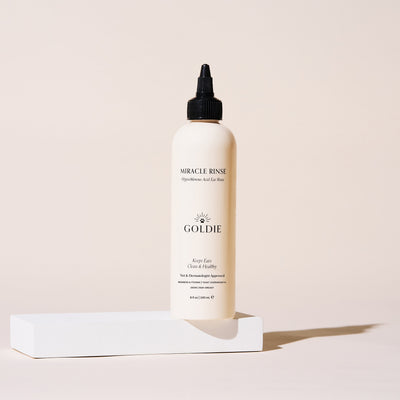
For example, Goldie’s Miracle Rinse is labeled for routine cleaning and lists itching and irritation associated with allergies among its intended uses.
But ear maintenance differs from treating an ear infection.
If your dog has an active infection, cleaning alone may not be enough.
When Should You Stop the DIY Approach?
This may be the most important section of the entire article.
A home ear-cleaning routine is not appropriate for every situation.
Contact your veterinarian if your dog has:
Significant pain
If your dog cries, snaps, pulls away, or won't let you touch the ear, don't force cleaning.
Heavy or unusual discharge
Especially yellow, green, bloody, or pus-like material.
A strong or foul odor
A persistent odor can accompany microbial overgrowth or otitis externa.
Severe redness or swelling
Inflammation can make even normally gentle products uncomfortable.
Repeated ear infections
Recurring infections frequently have an underlying cause such as allergies or anatomical factors.
Balance problems or a head tilt
These can indicate deeper ear involvement and warrant prompt veterinary evaluation.
Hearing changes
Don't treat a change in hearing as a simple ear-cleaning problem.
Another major reason not to experiment:
You need to know whether the eardrum is intact.
VCA advises against using HOCl topical ear products in pets with a ruptured tympanic membrane unless directed appropriately. At the same time, Merck emphasizes the importance of evaluating the tympanic membrane before applying certain topical ear treatments because some products can potentially cause ototoxic effects.
Build a simple daily skin routine
How to Clean Your Dog's Ears at Home
If your veterinarian has recommended routine cleaning, the technique matters almost as much as the product.
Merck Veterinary Manual recommends using a veterinary-recommended ear-cleaning solution and cotton balls rather than cotton swabs.
A basic routine looks like this:
1. Inspect the ear first.
Look for redness, swelling, discharge, excessive wax, sores, or anything unusual.
2. Use an ear product recommended for dogs.
If you're choosing HOCl, choose a product specifically formulated and labeled for animal ear use.
3. Apply according to the product directions.
Don't assume that more product—or more frequent cleaning—is better.
4. Gently massage the base of the ear.
This helps distribute the solution through the accessible portion of the canal and loosen debris.
5. Let your dog shake.
Yes, your walls may become involved.
This is normal and can help move loosened material toward the opening.
6. Wipe away the loosened debris.
Use cotton balls or gauze around the accessible part of the ear.
7. Never push cotton swabs deep into the ear canal.
You can push debris farther inward or traumatize the ear canal.
What About Dogs With Allergies?
This is where ear problems can become frustrating.
A dog may appear to have a recurring "ear infection" when the underlying issue is actually allergies.
Allergic inflammation can disrupt the skin barrier and create an environment where yeast or bacteria can overgrow. That's one reason some dogs seem to get ear problems again and again.
Cleaning can help manage debris and maintain the ear environment—but it doesn't address the underlying allergy.
If your dog repeatedly develops itchy ears despite regular cleaning, it's worth discussing allergies with your veterinarian rather than simply switching from one home remedy to another.
The Bottom Line: HOCl or Apple Cider Vinegar?
If you're standing in the kitchen holding a bottle of apple cider vinegar and wondering whether it's a good idea for your dog's itchy ears, the veterinary answer is fairly straightforward:
Put the vinegar back in the pantry.
While acetic acid has legitimate antimicrobial applications in veterinary medicine under controlled circumstances, that does not make DIY apple cider vinegar mixtures a good choice for an inflamed dog's ear. Veterinary references specifically caution against vinegar dilutions and other irritating home remedies.
Hypochlorous acid is a different story.
Veterinary-formulated HOCl ear products have a legitimate place in canine ear care. Published research evaluates HOCl in dogs with otitis externa, and veterinary references recognize HOCl formulations as topical ear-cleaning products.
You don't necessarily need a complicated home remedy. You need the right product for the job.
A properly formulated hypochlorous acid ear rinse can provide a convenient option for routine cleaning and mild irritation, while keeping the more serious problems—pain, infection, recurrent inflammation, or possible eardrum damage—in the hands of your veterinarian.
Because sometimes the best home remedy is knowing when not to DIY.
Frequently Asked Questions
Is hypochlorous acid safe for dogs' ears?
Can I use apple cider vinegar to clean my dog's ears?
Does hypochlorous acid kill yeast?
Can I make hypochlorous acid at home?
How often should I clean my dog's ears?