

Dog Paw Licking at Night: What It Means and How to Break the Cycle

Updated September 23, 2026 · 7 min read
Listen to this article
Read aloud in your browser. Product blocks and navigation are skipped.
In This Article
- Loading contents…
Dog paw licking at night can be driven by itch from allergies or irritation, a skin or nail injury, a foreign object, parasites, pain, infection that develops in inflamed skin, or a repetitive self-soothing or compulsive behavior. A few licks before bed can be normal grooming. Licking that keeps your dog awake, leaves the fur wet, or turns the skin red needs a closer look.
You probably hear it before you see it. Everyone settles down, the house gets quiet, and your dog starts working on the same foot again. You interrupt. They stop for a minute. Then it starts over.
The useful question is what makes that paw uncomfortable. A bedtime routine can help with everyday dirt and moisture, but recurring itch needs more than a wipe-down.
Start with the pattern: one paw or several?
Before reaching for a product, compare all four feet. Look at the pads, nails, skin between the toes, and the top of each paw. Keep the check gentle. Pulling away can be a sign of pain, not a request to hold the foot more firmly.
|
What you notice |
What it can suggest |
Your next step |
|---|---|---|
|
A few licks, then comfortable sleep |
Ordinary grooming |
Watch for a change in the pattern |
|
Several feet affected, often after outdoor time |
Allergies or contact irritation |
Clean off ordinary dirt, dry, and track when it happens |
|
Sudden attention to one foot |
A nail problem, injury, foreign material, an interdigital bump or lesion, or pain in the paw or elsewhere in the limb. |
Check gently; get help for limping, swelling, or persistent discomfort |
|
Red, greasy, swollen, or smelly skin |
Inflammation with possible infection |
Arrange a veterinary examination |
|
Repeated licking despite healthy-looking feet |
An early skin problem, pain, or a behavioral issue |
Share the pattern with your vet rather than assuming boredom |
These are clues to report, not a way to diagnose the paw at home. Our broader guide to why dogs keep licking their paws can help you connect the foot symptoms with changes elsewhere.
Why does it seem worse at night?
Sometimes nighttime is simply when you notice. Meals, walks, visitors, and play are over. With fewer distractions, a dog may spend more time attending to an itch that was already there.
The timing also gives you something practical to investigate. Does the licking begin after the last walk? After lying on a freshly washed blanket? Only on evenings spent in the yard? Write down what happened before it started. A short video can be more useful at the appointment than trying to remember how often your dog did it.
Nighttime alone doesn't identify the cause. It isn't proof of a yeast infection, and it doesn't establish separation anxiety when your dog is lying beside you.
Common reasons dogs lick their paws: what drives excessive paw licking?
Environmental allergies
Pollen, mold, and dust mites can be involved in allergic skin disease. Look beyond the feet: ear scratching, face rubbing, and belly irritation may belong to the same pattern. Dogs can have allergy-related discomfort before obvious skin damage appears. Cornell's explanation of atopic dermatitis describes these signs and why treatment is individualized.
After-walk cleanup can reduce what stays on the coat. It won't remove every exposure or replace an allergy plan. If your dog is also scratching elsewhere, read Why Is My Dog So Itchy? for the bigger picture.
Food allergies
Food can be involved, but paw licking doesn't tell you which ingredient is responsible. Repeatedly switching bags, adding supplements, or cutting out entire food groups can make the picture harder to interpret.
If your vet recommends an elimination diet, ask exactly what your dog can eat during the trial, including treats, chews, flavored medicines, and food used for training. A controlled trial is very different from guessing that chicken must be the problem.
Irritation, infection, or an injured foot
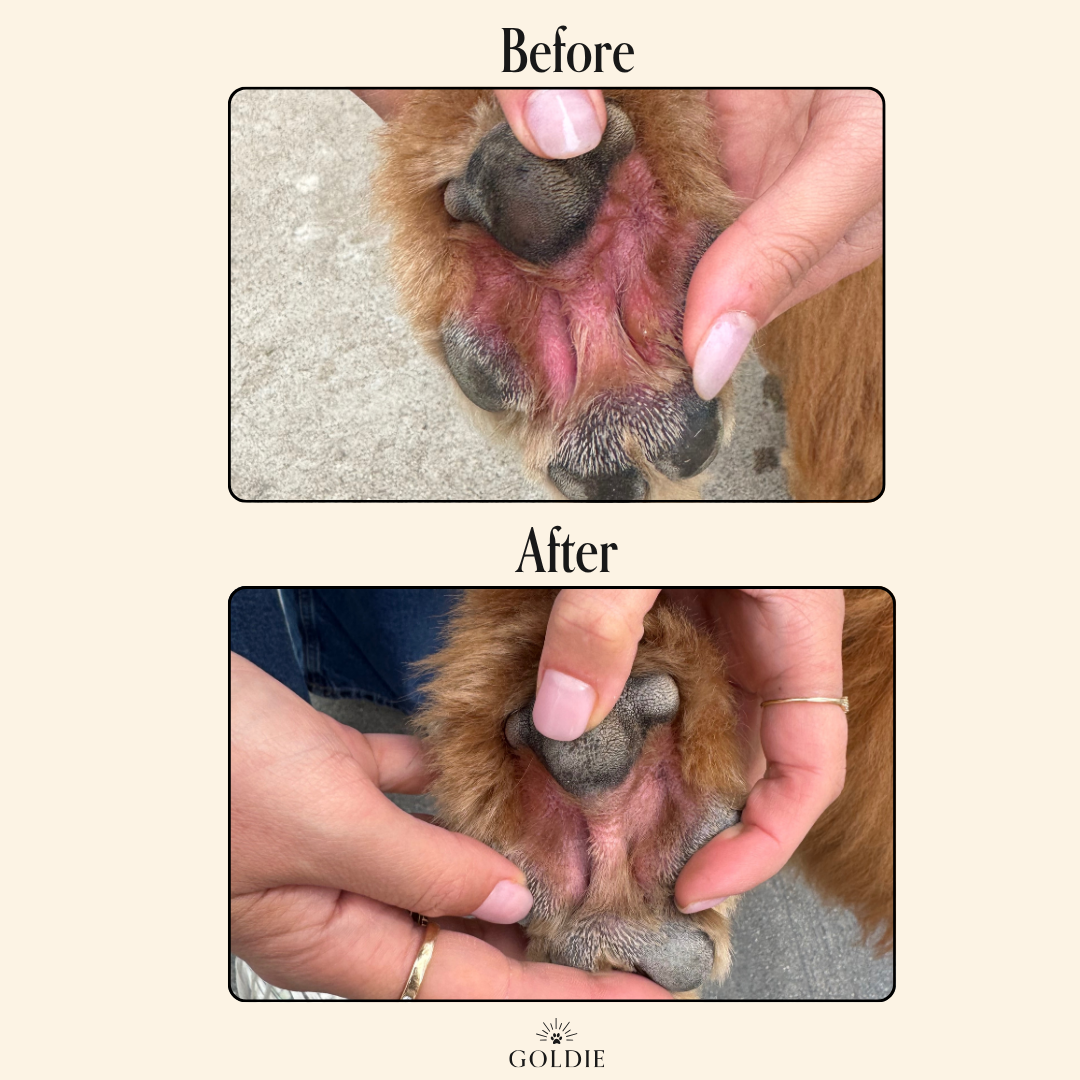
An uncomfortable patch may start the licking, and repeated licking can then keep the skin inflamed. Bacterial or yeast overgrowth may complicate already irritated skin, but odor and brown fur staining cannot tell you which organism, if any, is present. When infection is suspected, a veterinarian may perform skin cytology, often with a tape strip, swab, or slide impression, to look for bacteria, yeast, and inflammatory cells. Odor and brown fur staining don't tell you which organism is present. A veterinarian can examine a skin sample when infection is suspected. VCA's pododermatitis guide explains the range of problems that can affect a dog's feet.
A damaged nail or something caught between the toes calls for a different response from itchy skin on several feet. Remove only loose, easily accessible debris. Don't dig for a grass awn or squeeze a swollen lump.
A swollen bump between the toes, a recurrent draining spot, or persistent licking of one paw despite normal-looking skin deserves veterinary evaluation. Some problems begin deeper in the skin or may reflect pain elsewhere in the limb, not just surface irritation.
Dry skin and a damaged skin barrier
Check the paw pads as well as the fur. Rough, cracked, burned, or irritated pads can be uncomfortable, but a rough-looking pad is not a reason to start layering on human moisturizers. Sensitive skin needs an appropriate product, and deep cracks, raw skin, or open sores need veterinary care.
Chronic paw licking can damage the skin barrier and leave the area more vulnerable to secondary bacterial or yeast overgrowth. The resulting discomfort can prompt still more licking. Breaking that cycle means addressing the root cause and protecting the skin, not just interrupting your dog every few minutes.
Parasites belong on the checklist too. Fleas can cause intense itching, and mites can be involved in inflamed feet. Tell your vet which parasite preventive you use and when the last dose was given. A proper diagnosis may require skin testing; a paw photo cannot rule these problems out. Allergy testing is generally used to identify allergens for immunotherapy after a veterinarian has assessed other causes; it does not diagnose an allergy from paw licking alone. VCA's guide to inflamed paws covers these possibilities.
Boredom, anxiety, and compulsive licking
Some dogs continue licking as a learned or compulsive behavior. Physical discomfort should be investigated first. Calling it a habit too early can leave a sore dog trying to manage their own pain.
Once medical causes have been addressed, your vet may recommend changes to the evening routine or behavior support. Calm enrichment is useful for a comfortable dog; it isn't treatment for an untreated skin problem.
For a dog whose licking is linked to boredom or stress, appropriate daily exercise and mental stimulation can be part of the plan. Try short, predictable sessions with puzzle toys or a familiar training game. More exercise isn't automatically better, especially if your dog walks with a limp. Keep activity comfortable and ask about persistent behavioral patterns. VCA's guidance on compulsive disorders explains why medical assessment comes before a behavioral diagnosis.
A practical bedtime paw routine
1. Check before you clean
Take a quick look when you come in from the final walk. Note anything new before wiping it away. If the foot is bleeding, markedly swollen, painful, or producing discharge, contact your vet and ask what to do while waiting.
For ordinary dirty feet, set up your supplies by the door. A towel within reach makes this much easier than trying to persuade a wet dog to wait while you find one.
2. Remove the day's dirt
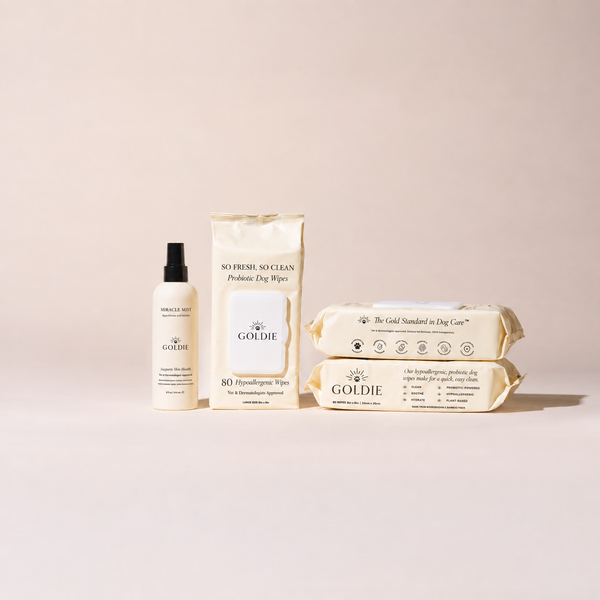
Goldie's So Fresh, So Clean Probiotic Wipes fit the everyday cleanup step. Use a clean part of the wipe for each paw and work gently around the pads. If mud is packed into the fur, a fresh-water rinse may be more practical than repeated rubbing.
If your dog has walked through a known pesticide, herbicide, fertilizer, de-icer, or other chemical, follow the product label and contact your veterinarian, an animal poison-control service, or the product manufacturer promptly for substance-specific guidance. Do not assume that a quick wipe is adequate decontamination, and prevent licking until you know what was contacted and how the paws should be cleaned.
3. Dry between the toes
Blot with a soft towel, including the spaces you just cleaned. Leaving the tops of the feet dry while the toe webs stay damp misses the area your dog may be licking most.
Avoid vigorous rubbing. If drying the paw seems painful, stop and have it checked.
4. Use targeted care when it fits
For a localized skin-care step, Goldie Miracle Mist is a topical option to discuss with your vet. Its formula contains 0.02% hypochlorous acid. Apply according to the label and let it dry; don't keep adding products because your dog has resumed licking.
An infected, ulcerated, or persistently painful paw needs a diagnosis and appropriate treatment. Bring the product name to the appointment so your vet can tell you whether and when it belongs alongside that plan.
5. Protect sore skin and help your dog settle
If licking is damaging the skin, ask about a properly fitted protective collar. Check that your dog actually cannot reach the affected foot. Some soft or inflatable collars leave paws accessible.
Don't improvise a tight wrap or leave a damp sock on overnight. Once your dog is comfortable, a quiet training game, suitable chew toy, or food puzzle can provide another way to wind down. There is no need to scold a dog for responding to an itch.
What to skip tonight
Avoid experimenting with alcohol, hydrogen peroxide, apple cider vinegar, essential oils, human anti-itch creams, or leftover medication. A homemade mixture can sting damaged skin, and a human product may be unsafe if licked.
Coconut oil doesn't identify the cause of paw licking. Adding it to a wet, irritated foot may also encourage more attention to the area. Keep the routine simple enough that you can tell whether your dog is improving.
Don't give Benadryl or another medicine just to make your dog sleep through the problem. Ask your vet about the exact formulation and whether it is useful for your dog's diagnosis.
When excessive licking needs veterinary care
Seek same-day veterinary guidance if your dog is suddenly very painful, will not bear weight, has a broken or bleeding nail, marked swelling, pus or other discharge, a rapidly enlarging lump, an open wound, or possible exposure to a harmful chemical. Seek urgent care for severe pain, uncontrolled bleeding, or signs of a serious reaction after chemical exposure.
Bring a simple record: which feet, when it starts, any ear or belly symptoms, recent grooming, and everything you've applied. If the fur has a corn-chip smell, mention it, but don't assume that identifies yeast. Our Frito-feet guide explains why smell needs context.