

Why Does My Dog Smell Like Fritos?
Wondering why your dog's paws smell like corn chips? That famous "Frito feet" scent is caused by natural bacteria and yeast living between their toes. Learn what a faint vs. strong odor means, when it points to an underlying overgrowth, and how simple daily care can keep your dog's paws healthy.

Updated August 10, 2026 · 4 min read
Listen to this article
Read aloud in your browser. Product blocks and navigation are skipped.
In This Article
- Loading contents…
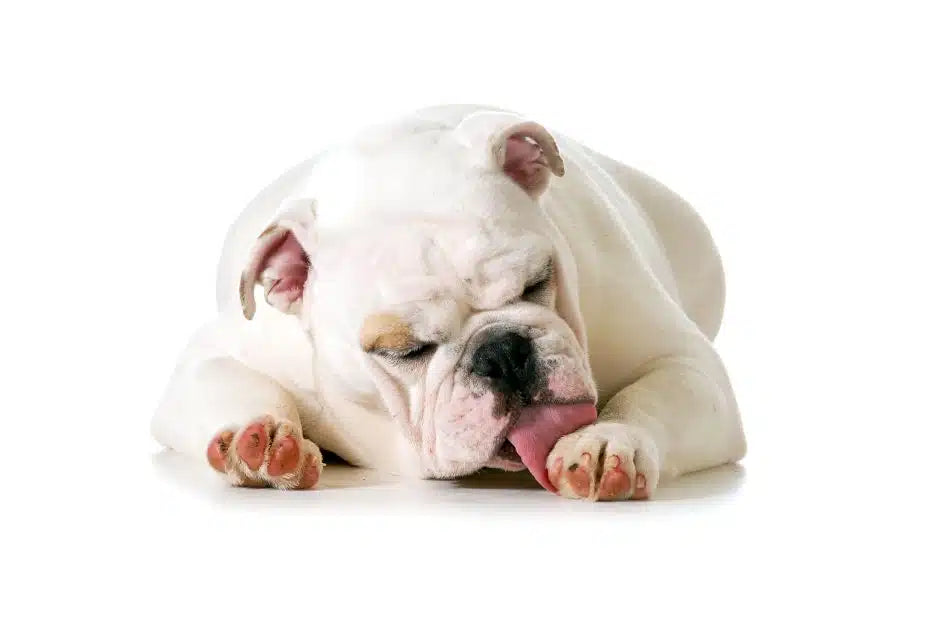
The short answer: Why does my dog smell like Fritos? This is a common question among dog owners. That corn-chip or "Frito feet" smell comes from naturally occurring bacteria and yeast, mainly Proteus and Pseudomonas bacteria and Malassezia yeast living on your dog's paws. A faint smell is normal and harmless. A strong, persistent Frito smell means those microbes are overgrowing, usually because moisture is getting trapped between the toes.
You've done it. Everyone has. You picked up a paw, sniffed it, and got a full blast of corn chips. Then you sniffed the other one to check.
The Frito-like smell is often explained by the fact that normal paw bacteria and yeast become more noticeable. Frito feet is one of the most beloved oddities of living with a dog — and it has a real, specific microbiological explanation. It's also one of the few smells that tells you something useful about your dog's skin health, if you know what the intensity means. From $23.00
Miracle Mist
$51.00
Frito feet, explained.
Every dog's skin hosts a microbiome: a resident population of bacteria and yeast that is completely normal and, when in balance, actively protects the skin. Paws are the sweatiest, dampest, most microbe-friendly real estate on a dog's body. Dogs sweat through their paw pads, and that moisture collects in the dark, warm spaces between the toes.
Some of those resident microbes, particularly Proteus and Pseudomonas bacteria, produce volatile compounds that smell remarkably like corn chips. Malassezia, the yeast that lives on normal dog skin, contributes its own musty, yeasty note to the mix.
So a whiff of Frito while your dog is stretched out next to you is not a problem. It's a normal, healthy paw doing normal, healthy paw things.
When the Frito smell is a warning sign
The intensity of the smell scales with the microorganism population. A faint smell means a normal microbiome. A smell you can notice from across the couch means something has multiplied.
Treat the smell as a symptom if it's strong, or if it comes with any of these:
-
Redness between the toes or on the pads.
-
Rusty or brown staining of the paw fur.
-
Persistent licking or chewing of the paws.
-
Greasy, flaky, or thickened paw skin.
-
Hair loss or thinning around the pads.
-
The same musty smell is coming from the ears.
Overgrowth doesn't stay cosmetic. It itches; your dog licks it, which adds moisture, which feeds more overgrowth, and the cycle escalates toward raw, inflamed paws that are much harder to settle down.
Full guide: why dogs lick their paws →
Why do some dogs smell more than others
Moisture is the multiplier. Two dogs with identical microbiomes will smell very differently if one of them has consistently damp feet.
Dogs that tend to smell more:
-
Swimmers and water dogs: repeated soaking, rarely fully dried.
-
Dogs in humid climates: nothing between the toes ever fully evaporates.
-
Allergic dogs: allergic skin reliably carries higher yeast and bacterial populations.
-
Hairy or webbed feet: fur between the pads holds water like a sponge.
-
Dogs with skin folds: the same trapped-moisture problem, in more places.
-
Dogs who don't get dried off: the day's rain, dew, and puddles stay on board.
Breeds that come up most often: Frenchies, Bulldogs, Golden Retrievers, Labs, Doodles, Basset Hounds, and Cocker Spaniels. A mix of allergy-prone breeds, fold-heavy breeds, and enthusiastic swimmers.
How to manage Frito feet at home
The goal isn't a sterile paw that's neither possible nor desirable. The goal is to keep the resident microorganism population in balance so it stays quiet.
1. Dry the paws after every wet event
Rain, wet grass, swims, baths, puddles. Between the toes, not just the pads; that's where the water actually sits. This is the highest-impact habit on the list, and it takes thirty seconds.
2. Rebalance the paw microbiome
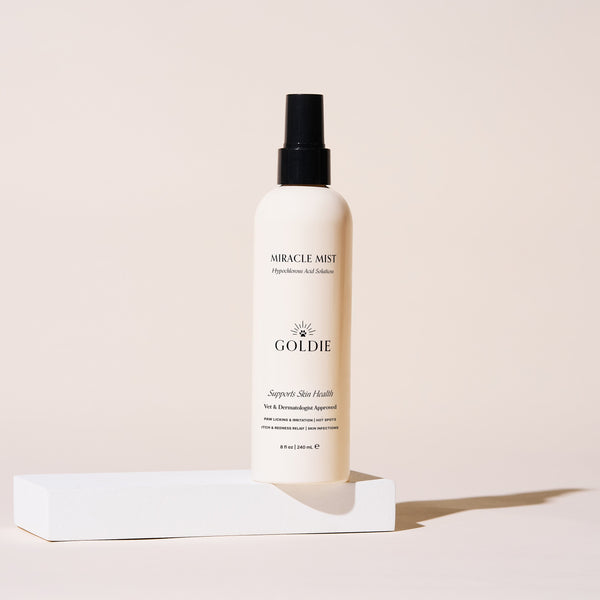
Goldie Miracle Mist is a vet and dermatologist approved spray formulated with hypochlorous acid, a clinically recognized broad-spectrum antimicrobial that helps regulate the skin microbiome, making it harder for odor-producing yeast and bacteria to overgrow. No harsh ingredients, sting-free, and completely lick-safe, which matters because whatever goes on a paw ends up in your dog's mouth. Spray between the toes and let it air dry.
3. Wipe down after walks
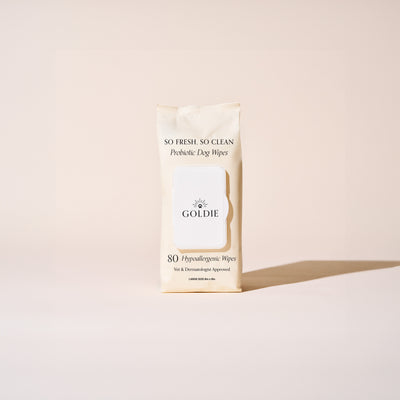
Goldie Probiotic Wipes remove allergens and the organic residue microbes feed on, while supporting healthy skin flora. Get into the webbing between the toes, not just across the top of the paw.
4. Trim the fur between the pads
If your dog has hairy feet, keeping that fur short dramatically speeds up paw drying. Ask your groomer to tidy the pads at each visit.
5. Freshen the coat, don't mask it
If it's not just the paws and the whole dog smells, perfume makes the problem invisible for an hour and unchanged underneath. A lick-safe deodorizing spray like Goldie Quick Spritz addresses odor at the microbial source instead of layering fragrance over it. Dogs smell like corn chips when odor-producing microbes on the skin and paws become overactive, often because of trapped moisture or an unbalanced paw microbiome.
When to see your vet
Book a visit if the smell comes with:
-
Limping, swelling, or signs of pain.
-
Open sores, bleeding, or raw skin.
-
Hair loss around the pads or nail-bed changes.
-
Spread to the ears or skin folds.
-
No improvement after two weeks of consistent home care.
Persistent, strong odor across multiple areas usually points to an underlying allergy driving the overgrowth. That's worth diagnosing properly; dogs whose allergies are well managed stop relapsing every few weeks.
Build a simple daily skin routine
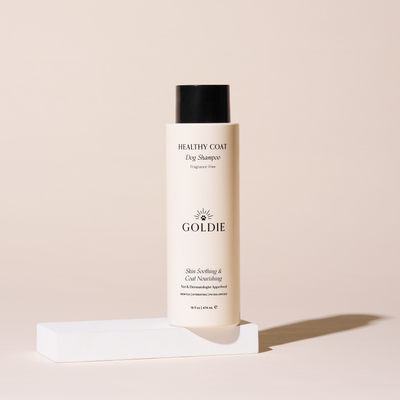
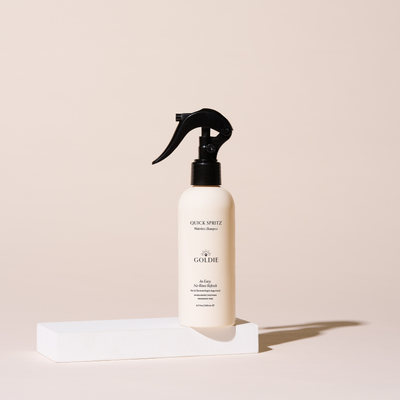
Frequently Asked Questions
Is it normal for my dog's paws to smell like corn chips?
Does the Frito smell mean my dog has a yeast infection?
How do I get rid of the Frito smell on my dog?
Why do my dog's ears smell like Fritos, too?
Should I stop letting my dog swim if his paws smell?