

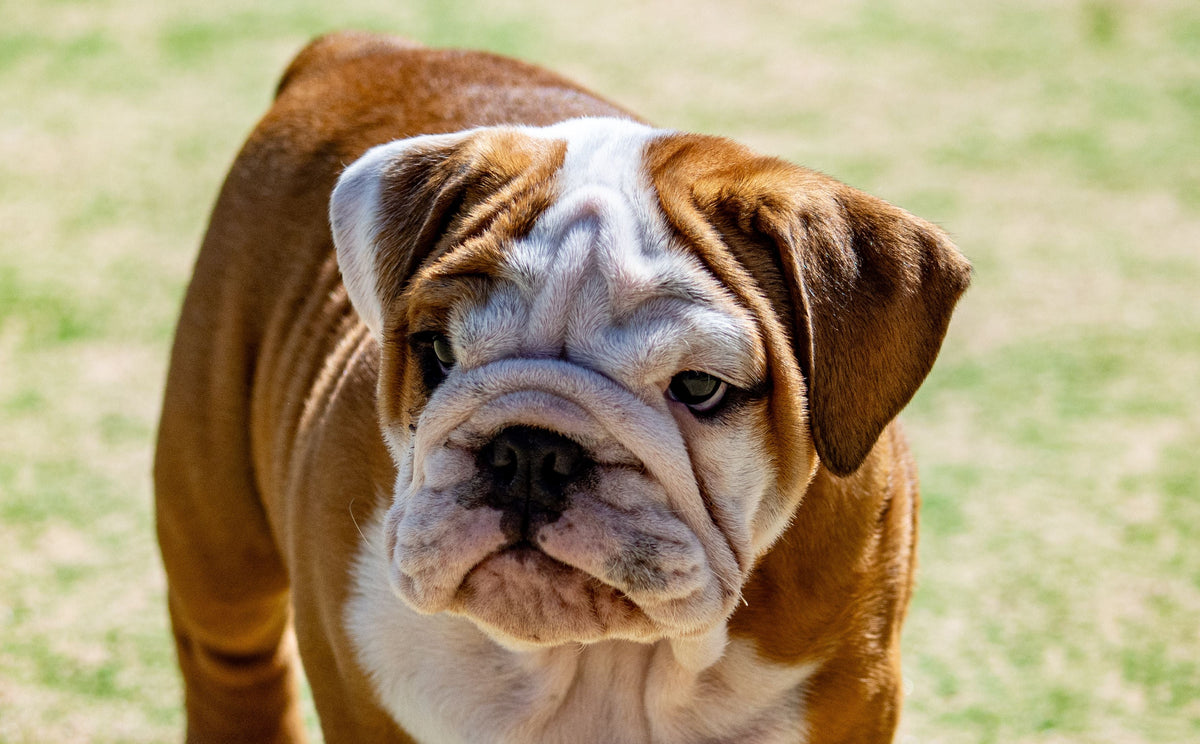
Bulldog Wrinkle Care (English & French Bulldogs, Pugs)
Bulldog wrinkles trap moisture and skin oils, making folds vulnerable to red, smelly yeast and bacterial infections. Learn the biological causes behind fold dermatitis, key signs to watch for, and the simple clean-treat-dry routine needed to keep your dog's skin calm and healthy.

Updated August 10, 2026 · 10 min read
Listen to this article
Read aloud in your browser. Product blocks and navigation are skipped.
In This Article
- Loading contents…
Bulldog wrinkles get irritated and infected because the skin inside each fold stays moist, airless, and pressed against itself, trapping oils, debris, and humidity that feed yeast and bacteria. If you are wondering how to treat infected bulldog wrinkles, the most effective approach is a consistent clean-treat-dry routine.
Red, smelly, or gunky folds are early signs of fold dermatitis (intertrigo), and a consistent clean-treat-dry routine is what keeps it from progressing.
Wrinkle care looks simple on paper — wipe, treat, dry — and it trips up English Bulldog, French Bulldog, and Pug owners every single day. Usually not because they're doing it wrong, but because they stop as soon as the fold looks better.
I want to give you the number that reframes this whole task. In a UK study of more than 900,000 dogs, English Bulldogs had 49 times the odds of skin fold dermatitis compared with crossbred dogs. French Bulldogs, 26 times. Pugs, 16 times. Among cases that reached a veterinarian, 42% were treated with systemic antibiotics.
That last figure is the one I'd like to change. Fold dermatitis is a surface infection on the outside of your dog, which means the international treatment guidelines say it should usually be managed topically — not with oral antibiotics. What happens at your bathroom counter three or four times a week genuinely determines whether your dog ends up in my exam room on a course of antibiotics.
Why Bulldog Wrinkles Get Irritated and Infected
English Bulldogs, French Bulldogs, and Pugs are brachycephalic — bred for shortened skulls and compressed facial bones, which push the skin of the face into folds around the muzzle, eyes, and lips. Those folds aren't decorative extras. They're closed micro-environments.
Inside a fold, two skin surfaces press together. There's friction, there's no airflow, and there's a steady supply of moisture: tears from the eyes, drool from the lips, water from the bowl, humidity from the air. Skin that stays damp softens, and its barrier weakens. The bacteria and yeast that live harmlessly on every dog's skin — Malassezia, Staphylococcus, sometimes Pseudomonas — find ideal conditions and multiply. Their byproducts inflame the softened skin, and you get the trio every bulldog owner recognizes: redness, sour odor, sticky brown gunk.
We call it fold dermatitis, or intertrigo. It falls under the umbrella of surface pyoderma, alongside hot spots.
The epidemiology is stark. In the VetCompass analysis of UK primary-care records, the annual prevalence of skin fold dermatitis was 6.05% in English Bulldogs, 2.69% in French Bulldogs, and 2.11% in Pugs, against 0.37% across all dogs. Flat-faced breeds overall ran at 1.02% versus 0.26% in medium-muzzled breeds. In the same dataset, the facial, nasal, and around-the-eye folds were the dominant locations in all three of these breeds, which is exactly where owners find it hardest to use anything harsh.
Risk also rises with age. This is not a puppy problem your dog grows out of.
Each breed's problem map
English Bulldogs carry the deepest folds of the three: a thick nose rope across the muzzle that catches tears, food, and drool all day; heavy cheek and lip folds; and a tail pocket. Most English Bulldogs have some degree of screw tail — a Bulldog Breed Council survey found 75% of exhibited bulldogs did, which creates deep, redundant folds at the tail base that collect moisture and fecal residue. Untreated tail fold dermatitis can progress to deep pyoderma with ulcers and sinus tracts, and it is genuinely painful. Dogs often show it by scooting, tail-chasing, or objecting to being touched near the rear.
French Bulldogs have fewer facial folds, but they tend to be deep, especially around the nose and eyes. The under-chin area traps drool, and tear staining is often the first visible sign that a periocular fold has been damp for a while. Frenchies can have tail folds, too, though tail fold intertrigo is considerably less common in them than in English Bulldogs. (More breed-specific detail in our French Bulldog skin issues guide.)
Pugs have one large nose roll, shallower cheek folds, and neck rolls. Because Pugs shed heavily, dead hair accumulates in the folds and traps moisture and oil against the skin — a detail that owners of short-coated dogs consistently underestimate. A smooth coat does not mean a low-maintenance face.
All three breeds also carry related conformational issues that feed the problem: tear overflow from eye conditions keeps facial folds permanently wet, and lip folds set the stage for lip-fold pyoderma, which is its own distinct headache.
Healthy fold vs. infected fold
Healthy: pale pink skin inside, no odor, no discharge, no flinching when you open it.
Early irritation: mild redness, a slightly damp feel, a faint sour smell. Your dog rubs his face on the carpet, the sofa, or your leg. A thin brown or clear residue comes away on the wipe. This is the stage to act — it responds to home care within days.
Established infection: angry red or purplish skin, raw patches or ulcers, thick brown, yellow, or green discharge crusting at the fold edges, and an odor that's shifted from sour to strongly yeasty or rotten. Your dog yelps, snaps, or pulls away.
Red flags — vet this week, not more wipes: swelling around the muzzle or eyes, blood or pus in a tail pocket, sudden intense pain, or systemic signs like fever and lethargy.
The routine: clean, treat, dry
Set up first. Everything within arm's reach keeps the session under 2 minutes, and a short session is one your dog tolerates.
Step 1 — Clean the fold
Use one hand to open the fold, lifting the upper edge so you can see the full depth. With the other, draw a wipe from one end to the other in a single smooth motion. Don't scrub — the skin in there is already compromised. Deep folds may need a second pass with a fresh wipe.
Goldie So Fresh Probiotic Wipes are what I'd reach for here: gentle enough for daily use on facial skin, safe if licked, and sized for getting into a nose rope without dragging. Whatever you use, it needs to be dog-specific and fragrance-free.
Check what comes off. Brown residue or a sour smell means that fold needs daily attention until it's clean and odor-free.
What not to use: scented baby wipes or makeup wipes. Alcohol, fragrance, and human preservatives sting thin fold skin and dry it out, which makes the barrier worse, not better.
Step 2 — Treat the skin
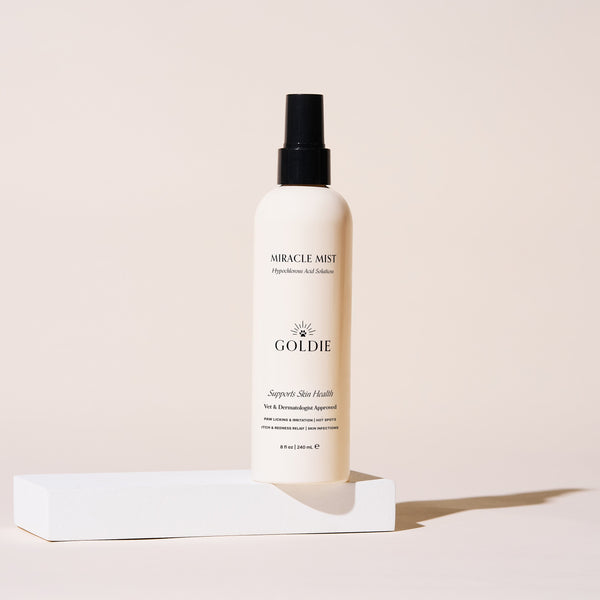
Mist Goldie Miracle Mist into the open fold until the skin is lightly coated. Let it sit for about 30 seconds, then move on to drying.
Here's why I'm comfortable recommending hypochlorous acid specifically for faces. The 2025 ISCAID canine pyoderma guidelines — the international standard for treating these infections — state that topical antimicrobial therapy alone is the treatment of choice for surface pyoderma, including intertrigo. They go further: where erosions or ulcers are present, hypochlorous acid products may be preferred, because they're safe in open wounds, in eyes, and on mucous membranes.
That safety profile is the whole reason this works on a bulldog. A nose rope sits directly beneath the eyes. A lip fold is in licking range every second of the day. Most effective antiseptics can't be used there. Hypochlorous acid — the same compound your dog's own white blood cells produce — can be, and Miracle Mist is formulated to be lick-safe and gentle enough for daily use in exactly these areas while helping reduce the microbial overgrowth driving the redness and odor.
Those same guidelines make one more point I want owners to hear: proactive antiseptic treatment on previously affected skin may help prevent recurrence. It can be continued long-term, where the underlying cause can't be fixed. Your dog's face is not going to stop being folded. That's the clinical argument for maintenance, from a source with no stake in selling you anything.
What not to use: human diaper creams, triple-antibiotic ointments, petroleum jelly, or talc and cornstarch powders. Creams and jellies seal moisture into the fold, which is the opposite of the goal, and they get licked off. Powders cake into a paste that abrades the skin.
Step 3 — Dry completely
This is the step that separates dogs whose folds heal from dogs whose folds keep relapsing.
Blot the entire length and depth of the fold with a soft cotton pad, microfiber cloth, or tissue. Press and lift — don't rub. No hair dryers on hot settings; fold skin burns easily.
Then build the small habits: pat facial folds dry after your dog drinks, after rain or snow, after any bath. English Bulldogs, in particular, submerge the entire front of the face in the water bowl at every meal and soak the nose rope. Five seconds with a cloth prevents hours of trapped moisture.
If your dog smells again shortly after bathing, trapped fold moisture is usually the reason.
Step 4 — Repeat
Maintenance: 3–4 times per week, year-round. Active irritation: daily, or twice daily. Humid months, swimmers, heavy droolers: increase.
And treat every active fold in the same session. Cleaning the nose rope while ignoring an inflamed tail pocket just lets the two sites reseed each other.
From $23.00
Miracle Mist
$51.00
The at-home kit
For a dog with folds, three things cover the routine:
|
Step |
Product |
Use |
|---|---|---|
|
Clean |
Wipe the full depth of each fold; daily during flares, 3–4× weekly for maintenance |
|
|
Treat |
Miracle Mist (8 oz or 3.4 oz) |
Mist into the open fold for 30 seconds, then dry. Lick-safe and safe near eyes |
|
Dry |
Soft cloth or cotton pad |
Press and lift through the whole fold. Never skip |
The 3.4 oz Miracle Mist travels; the 8 oz is the better value for a household doing this four times a week. Both formulas were developed by Goldie's dermatology PA-C co-founder and credentialed by a Harvard-trained dermatologist and by me (meet the experts).
Realistic timeline: mild irritation usually starts improving within 48–72 hours of a twice-daily clean-treat-dry routine. Keep going daily until the skin is fully calm — not just "better." Stopping at "better" is the single most common reason a fold relapses within two weeks.
Preventing recurrence
Fold dermatitis is managed, not cured. Keeping bulldog wrinkles healthy requires consistent maintenance because the underlying anatomy does not change. The anatomy doesn't change, so prevention is about consistency and environment.
Keep the routine going between flares — 3–4× weekly year-round, daily in summer or humid climates.
Manage weight. Overweight bulldogs and pugs develop deeper folds and more skin-on-skin contact. This is one of the few risk factors you can genuinely reduce, and it also helps the breathing issues these breeds carry.
Manage the environment. Wash bedding weekly in hot water. Don't let your dog settle on damp grass or a wet patio. If your home runs humid, a fan or dehumidifier in the room your dog sleeps in helps more than owners expect.
Ask about underlying causes if it's chronic. Allergies, hypothyroidism, and food sensitivities inflame skin from the inside and make folds break down faster. If your dog's folds keep flaring despite consistent care, that's a conversation about allergy workup, not a reason to clean harder.
Trimming: some dogs grow tufts inside folds that hold moisture. A groomer or vet can trim these with blunt-tipped scissors. Don't attempt deep trimming at home — nicking fold skin creates exactly the infection you were trying to prevent.
Multi-pet households: if another dog or cat licks your bulldog's face or tail pocket, separate them during active healing. You're re-wetting the fold every time.
Build a simple daily skin routine
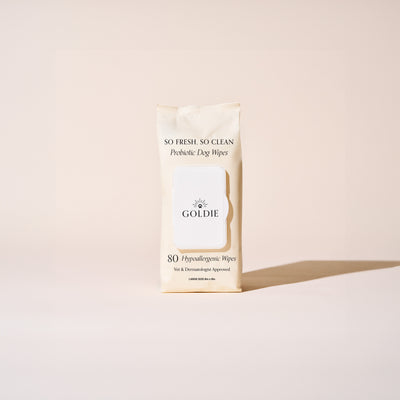
So Fresh, So Clean Probiotic Wipes
Removes dirt, allergens and irritants from paws, folds, and coat.
From $14.00
Shop
When home care isn't enough
Home care for mild fold dermatitis is well managed. When it doesn't, prompt treatment prevents a surface problem from becoming a deep one.
See us for: raw or bleeding folds, thick or bloody discharge, foul odor that doesn't resolve with cleaning, obvious pain, swelling around the eyes or muzzle, fever or lethargy, or no improvement after a full week of daily clean-treat-dry.
What we'll do: visual exam, skin scrapings or swabs, and cytology to determine whether bacteria, yeast, or both are overgrown. Cytology matters — the guidelines are clear that it should be performed before antimicrobials are used, and in that VetCompass dataset, only 4.2% of fold dermatitis diagnoses were supported by lab testing. If treatment fails or a resistant organism is suspected, we culture.
Treatment typically means prescription topicals, sometimes combined with a short course of topical or systemic anti-inflammatories when a primary itch or inflammation is driving it, and pain relief for heavily inflamed skin. Oral antibiotics are reserved for deep infections or cases where topical therapy has genuinely failed — not used first.
In severe, permanently re-infecting cases, surgical options exist: fold excision, or tail amputation for screw-tail dogs whose tail pockets can't be kept healthy. These are comfort procedures, not cosmetic ones, and they're a last resort.
Bring your products to the appointment. I can tell you what to continue, what to stop, and what to swap far more usefully than I can guess.
Life with a wrinkly dog
The "bulldog smell" people joke about usually isn't the coat. It's mildly infected folds and lip margins. Consistent wrinkle care often reduces overall odor dramatically within a week.
The comfort piece is real too, and it's underappreciated. Pain was recorded in nearly one in five dogs with clinical signs of fold dermatitis in that UK data — and dogs are poor at telling us. A dog who's become reluctant about face petting, cranky about collars, or less interested in lap time may simply be sore. Owners regularly tell me their dog became noticeably more affectionate after the folds healed, and they hadn't realized anything was wrong.
The anatomy can't be changed. But English Bulldogs, Frenchies, and Pugs live comfortably with healthy skin when the folds are kept clean, treated when they need it, and always dried.
Wrinkle care isn't a cure. It's a routine. The routine is the treatment.
Build the routine: Shop So Fresh Probiotic Wipes · Shop Miracle Mist
Dr. Tatiana Rogers, DVM, is a board-certified veterinarian and veterinary advisor to Goldie. This guide is educational and isn't a substitute for examining your individual dog. If your dog is in pain, has open or bleeding skin, or isn't improving with home care, see your veterinarian.
Frequently Asked Questions
What can I put on my bulldog's infected wrinkles?
How often should I clean bulldog wrinkles?
Why do my bulldog's wrinkles smell?
Can I use baby wipes or makeup wipes?
Do bulldogs and pugs outgrow wrinkle problems?
Is it safe to trim hair inside my dog's wrinkles?
Will better wrinkle care help my dog's breathing or snoring?