

Dog Skin Infections: How to Tell Bacterial, Yeast, and Irritated Skin Apart
Bacterial infection, yeast, and simple irritation can leave a dog's skin looking much the same, with redness, itch, flakes, or odor, so appearance alone can't tell them apart. Learn what each problem can look like, what your vet may check, why treatment depends on the finding, and how to keep a useful record at home.

Updated September 29, 2026 · 6 min read
Listen to this article
Read aloud in your browser. Product blocks and navigation are skipped.
In This Article
- Loading contents…
Bacterial skin infections, yeast overgrowth, and noninfectious irritation can all make a dog's skin red, itchy, flaky, or smelly. You can notice patterns, but you can't reliably tell them apart from appearance or odor alone. A veterinarian may examine skin samples to identify what is present and choose treatment. Some dogs have inflammation and more than one infection at the same time.
The useful goal at home is to describe the change clearly, protect uncomfortable skin, and avoid treating a guess as a diagnosis.
Key Takeaways
- You can't tell them apart by looking. Bacterial infection, yeast, and irritation can all make skin red, itchy, flaky, or smelly.
- More than one problem can be present. Allergic skin can become infected after scratching damages it.
- Smell is only one clue. It can't show how much yeast is present or whether bacteria are involved.
- Tests guide treatment. Skin cytology, scrapings, culture, or biopsy answer different questions.
- Grooming isn't treatment. Wipes, sprays, and shampoos support care but don't replace prescribed medication.
- Know when to call. Spreading redness, pus, painful swelling, extensive sores, or a dog who seems unwell need prompt help.
What different skin problems can look like
Use these signs as a description to share with your vet. They overlap too much to serve as a home diagnostic chart.
| Possibility | Signs you might notice | What helps distinguish it |
|---|---|---|
| Bacterial pyoderma | Pimples or pustules, crusts, circular scaly edges, patchy hair loss | Examination and skin cytology; culture when indicated |
| Yeast-associated dermatitis | Itch, greasy scale, odor, redness, or thickened skin | Microscopic evaluation interpreted with the clinical signs |
| Allergy or contact irritation | Redness, licking, scratching, changes linked to an exposure | History, examination, and investigation of alternative causes |
| Parasites or ringworm | Variable itch, scale, crusting, or hair loss | Appropriate parasite or fungal testing |
The terms describe possibilities, not exclusive boxes. A dog can start with allergic inflammation, damage the skin by scratching, and then develop secondary infection.
A dog can start with allergic inflammation, damage the skin by scratching, and then develop secondary infection.
Dr. Tatiana Rogers, DVMBacterial skin infection: what pyoderma means
Pyoderma is commonly used for a bacterial skin infection. Superficial disease may involve pustules, crusts, scale, and thinning patches of hair. Deeper disease can be painful and may produce swelling or draining lesions.
You may hear superficial bacterial folliculitis when infection involves hair follicles, or deep pyoderma when it extends farther into the skin. Those terms help explain why a few surface bumps and a painful draining lump need different plans.
Normal skin has bacteria on it. Infection often develops when the skin environment or barrier changes. That means a bacterial finding isn't necessarily evidence that your dog was dirty or that you missed a bath. The Merck Veterinary Manual's pyoderma overview explains the distinction between surface, superficial, and deeper disease.
At home, note where the lesions are. A few bumps on the belly, a sore skin fold, and a painful swelling between the toes give the vet different starting points. Don't squeeze pustules or pick crusts to see underneath.
Yeast: why smell is only one clue
Yeast can live on normal skin. When it contributes to dermatitis, the skin may become itchy, greasy, scaly, or thickened. Smell may draw your attention, but it can't tell you how much yeast is present or whether bacteria are involved too.
The yeast commonly discussed in canine skin disease is Malassezia. Finding it in a sample has to be interpreted alongside your dog's symptoms. A yeast infection and a bacterial infection can coexist; choosing between them from a picture misses that possibility.
VCA's yeast dermatitis guide describes the need to examine the skin and collect samples. For dog parents, the practical takeaway is to photograph the visible changes and describe the discomfort rather than diagnose from a “yeasty” smell.
If odor is the main thing you've noticed, our Frito-feet guide explains why a faint familiar scent and an inflamed, painful paw are different situations.
Irritated skin can exist without an infection
Skin can be inflamed because of allergic disease, friction, an unsuitable product, or another trigger. It doesn't automatically need an antibiotic. Equally, an irritated patch can develop an infection later, so a changing appearance deserves reassessment.
Try to identify the timeline. Did redness start after grooming? Does the dog itch seasonally? Is a harness rubbing the same area? Have you applied several products since the problem began?
The AAHA allergic-skin-disease guidelines emphasize a diagnostic approach that considers infections and parasites alongside allergic disease. Your vet may need to address more than one piece of the problem.
What the vet may do
A skin sample can often be collected with tape, a slide, or a swab. Other tests may include skin scrapings, culture, or a biopsy depending on the findings. Not every dog needs every test. Skin cytology is often the first test used to look for bacteria, yeast, and inflammatory cells; skin scrapings help investigate mites, while fungal culture or other testing may be used when ringworm is suspected.
Ask what question the proposed test answers. Is the aim to identify bacteria, check for yeast, rule out mites, or investigate a lesion that doesn't look typical? Understanding that purpose makes the plan easier to follow.
If the problem is recurrent, bring a list of previous treatments and what happened afterward. Include the exact product, duration, whether the skin cleared, and how quickly it changed again. Photos from before treatment can be especially useful.
Treatment depends on the finding
Many surface and superficial bacterial infections can be managed with appropriate topical therapies, including medicated shampoos or other formulations selected for the affected area. Deep pyoderma generally requires systemic antimicrobial treatment, usually guided by bacterial culture and susceptibility testing, with topical care often used alongside it. Superficial cases that cannot be managed effectively with topical therapy alone may also need systemic treatment. Yeast infections may need antifungal medications. Allergic inflammation and parasitic infections need their own management.
Your veterinarian chooses the formula, application method, frequency, and follow-up. A medicated wipe and a grooming wipe can look similar on the shelf while serving different purposes.
Don't borrow another pet's prescription or stop because the surface looks better after a few applications. Also don't keep applying a product that appears to cause worsening redness or pain. Call the clinic and explain the change.
Where Goldie products belong
Everyday cleanup
So Fresh, So Clean Probiotic Wipes can help with ordinary dirt on paws and coat when the skin tolerates routine grooming. For dogs with folds, clean accessible surfaces gently and avoid leaving moisture behind. Our skin-fold guide gives that area its own attention.
Don't scrub infected, ulcerated, or painful skin as though it were a dirty patch of fur. Ask whether wiping is appropriate during treatment.
Localized topical care
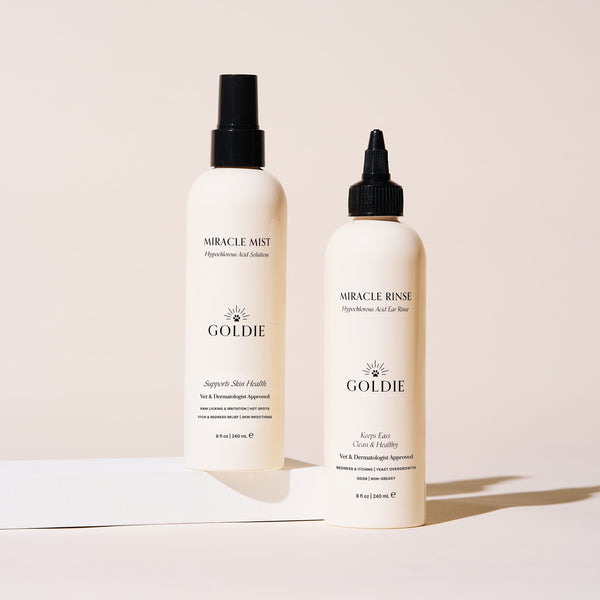
Goldie Miracle Mist is a skin-care option to discuss with your veterinarian. Bring it into the conversation as a specific product with specific directions, not as a replacement for an antibiotic or antifungal selected for a diagnosed infection.
Ask whether the area should be cleaned first, whether another medication needs to remain undisturbed, and how to prevent licking during care.
Routine bath days
Healthy Coat Shampoo can fit regular bathing when a gentle grooming shampoo is appropriate. If the vet prescribes a medicated wash, follow that plan and ask when your regular shampoo can return. Using both on the same day without guidance may make the routine more complicated than it needs to be.
A useful home record
Keep one short note rather than trying to memorize every change:
- Where the problem started and where it has spread.
- Whether itch, odor, redness, or hair loss appeared first.
- Changes in sleep, walking, eating, or tolerance of touch.
- Recent baths, grooming, swimming, or product changes.
- All medications, supplements, and parasite prevention.
If your dog keeps licking their paws or has itching in several areas, include those details even when one patch looks worst. Skin problems don't always respect the boundaries of the appointment topic.
Build a simple daily skin routine
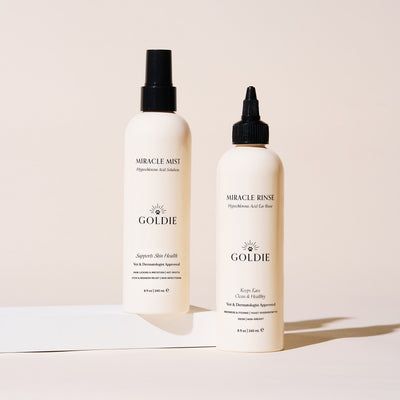
Miracle Duo
Skin and ears are usually part of the same allergy picture. Pair Miracle Mist with Miracle Rinse and cover both — from $51.
From $51.00
Shop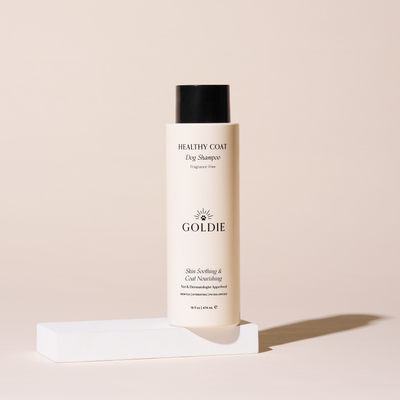
When to seek prompt help
Call for: spreading redness, pus, painful swelling, extensive sores, or a dog who seems unwell. Rapid deterioration, severe pain, or major swelling requires urgent advice.
Call for spreading redness, pus, painful swelling, extensive sores, or a dog who seems unwell. Rapid deterioration, severe pain, or major swelling requires urgent advice. Don't wait for a cosmetic grooming routine to improve those signs.
Wash your hands after handling affected skin and keep children away from draining sores. Ask about household precautions because some look-alike conditions, including ringworm and certain parasites, can spread. The diagnosis determines the practical precautions.
Give each part of skin care a clear purpose
Start with a diagnosis when the skin is persistently uncomfortable. Then build an everyday routine with the Goldie products that suit your dog and the treatment plan.
You don't have to identify an organism by sight. Noticing the pattern, protecting the skin, and following through on care are useful work you can do well.
This guide is educational. A veterinarian should assess suspected infection and choose the appropriate treatment.Frequently Asked Questions
Can a photo tell me whether it's bacteria or yeast?
Does a bad smell always mean infection?
Are all dog skin infections contagious?
Does every bacterial infection need oral antibiotics?
Can allergies and infection happen together?
Should I bathe before the appointment?
Can Goldie wipes replace medicated wipes?
Why does the rash keep coming back?